
Fitness & Movement
Running for Beginners: Start Without Wrecking Your Knees
An eight-week run-walk plan with exact intervals, why beginners get injured by volume rather than form, and what research says about running and knees.
14 min read
Work out your running pace (min/km) and speed from a distance and time, plus predicted finish times for 5K, 10K, half and full marathon using Riegel's formula.
Updated: September 7, 2026 · 🔒 Your data never leaves your browser
Running pace is your time per kilometre: 10 km in 50 minutes is a pace of 5:00 min/km and a speed of 12 km/h. Enter the distance and time of your run — the calculator gives your pace, speed and predicted finish times for 5K, 10K, half and full marathon.
Time
h
min
sec
Pace
5:00
min/km
Speed
12.0
km/h
Predicted times by distance
Estimated with Riegel's formula from your result, assuming similar fitness. It's accurate from roughly 1500 m to the marathon and drifts for sprints and ultras. A real marathon depends heavily on endurance and fuelling, not just your current pace.
From a single run it answers three questions.
Pace — minutes per kilometre (min/km). This is the runner's working unit: training and race splits are planned in pace. A lower number is faster.
Speed — kilometres per hour (km/h). The same thing, but the familiar form for a gym treadmill, which is set in km/h.
Predicted times for 5K, 10K, half and full marathon — an estimate of what to expect at other distances on your current form.
The prediction uses Peter Riegel's formula (1981):
| Term | Meaning |
|---|---|
| T₂ = T₁ × (D₂ / D₁)^1.06 | Time at the new distance |
| T₁, D₁ | Your time and distance from the run |
| D₂ | The distance you're predicting for |
| 1.06 | Exponent: pace slows slightly as distance grows |
The 1.06 exponent captures a simple fact: the longer the distance, the slightly slower your average pace — you can't hold 5K pace over a marathon. So a marathon predicted from a 5K is always slower than simple multiplication.
Time
h
min
sec
Pace
5:00
min/km
Speed
12.0
km/h
Predicted times by distance
Estimated with Riegel's formula from your result, assuming similar fitness. It's accurate from roughly 1500 m to the marathon and drifts for sprints and ultras. A real marathon depends heavily on endurance and fuelling, not just your current pace.
The formula assumes you're equally prepared for every distance. In practice you're not:
The practical takeaway: a prediction to a neighbouring distance (10K to half marathon) is usually close, while a jump 'from 5K to marathon' should be read as a ceiling, not a plan.
Читайте также: Running for Beginners: How to Start and Stick With It
The same running speed does different jobs depending on your heart rate. Most of your mileage is best run slowly — in 'zone 2', where you can hold a conversation. It's easy running that builds endurance, not constant all-out effort.
Читайте также: Zone 2: Why Slow Running Makes You Faster
Читайте также: Heart Rate Zones: How to Calculate and Why They Matter
Divide your time by the distance. Run 10 km in 50 minutes and that's 300 seconds per kilometre, i.e. a pace of 5:00 min/km, or 12 km/h. The calculator above does this instantly and converts between the two.
They're the same thing expressed differently. Pace is minutes per kilometre (lower is faster); speed is kilometres per hour (higher is faster). Runners usually think in pace (min/km), while a gym treadmill is set in speed (km/h).
The prediction uses Riegel's formula from your result and is accurate from roughly 1500 m to the marathon, assuming similar fitness. But the longer the distance, the more the result depends on endurance and race-day fuelling, not just your current pace. A real marathon is almost always slower than the 'maths' unless you've put in the mileage.
'Good' depends on age, sex and experience. Rough amateur benchmarks: an easy jog is 6:00–7:00 min/km, a solid recreational 10K pace is around 5:00–5:30, and 4:30 or faster is a trained level. What matters more than the absolute number is your progress relative to yourself.
An eight-week run-walk plan with exact intervals, why beginners get injured by volume rather than form, and what research says about running and knees.
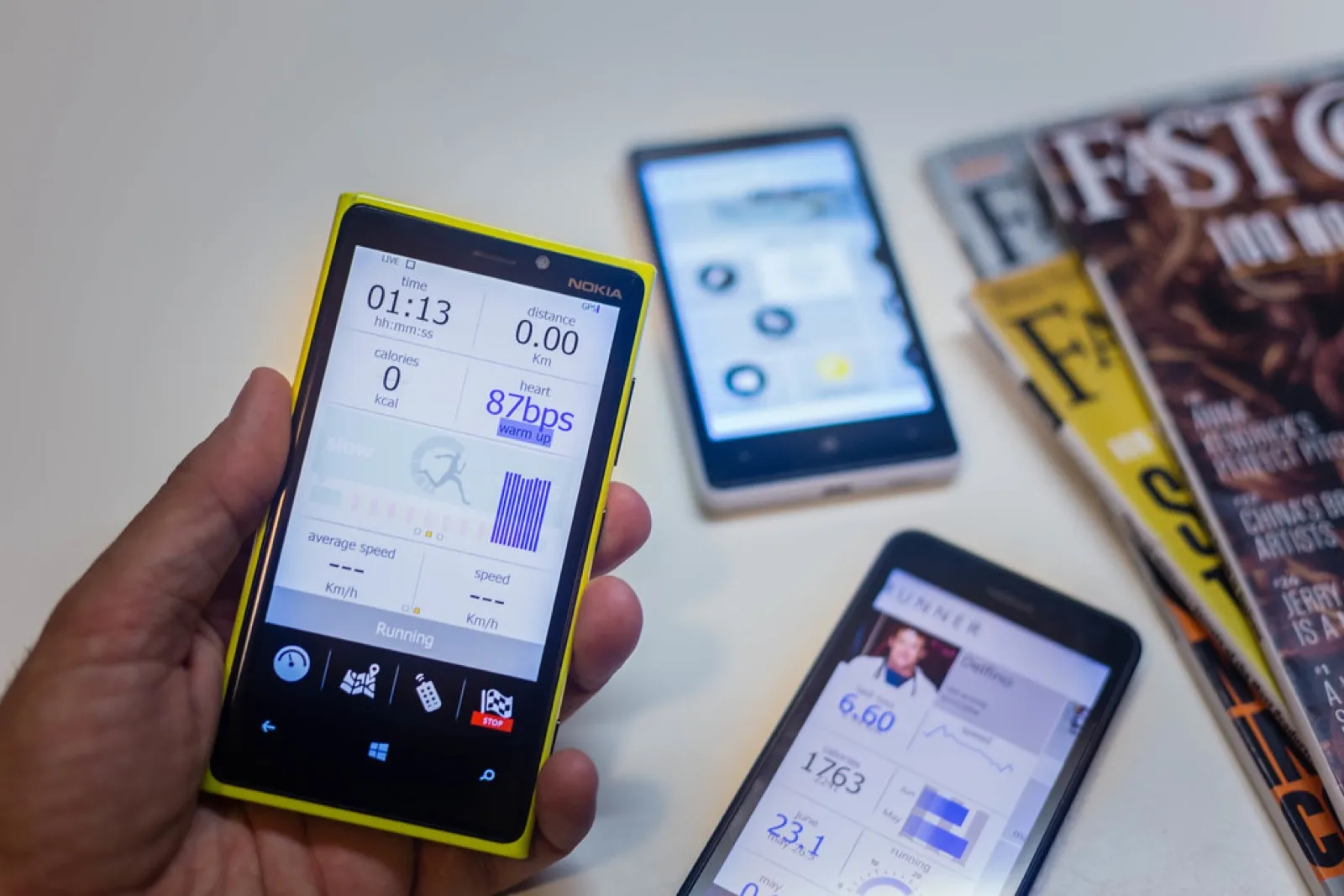
How to set heart rate training zones without a lab test, why 220 minus age is unreliable, how the Karvonen method works, and what Zone 2 actually builds.
What zone 2 actually is, how to find it without a lactate test, how much time it deserves, and why the polarized model beats the familiar habit of running everything at a medium pace.