Osteoporosis: The Prevention That Starts in Your Thirties
How bone tissue works, why peak bone mass is set before 30, what menopause changes, who needs a DXA scan, and which measures genuinely reduce fracture risk.
Contents
Osteoporosis is almost always discussed after a fracture has already happened. That is the inconvenient property of the disease: it does not hurt and gives no sign of itself until a bone breaks in a fall from standing height. Yet the window in which prevention is most effective opens decades earlier — in your early twenties, while the body is still building peak bone mass.
How bone works
Bone is not an inert mineral frame but living tissue in constant remodelling. Osteoclasts break down old sections while osteoblasts build new ones. A full remodelling cycle takes several months, and over ten years the skeleton renews itself almost entirely.
While building outpaces breakdown, bone mass grows. That period ends at roughly 25–30, when peak bone mass is reached. After that the balance first levels out and then tips towards resorption.
Hence the central point of prevention: the size of that peak determines the reserve available for the rest of your life. Estimates suggest a 10% higher peak bone mass delays the onset of osteoporosis by about 13 years. Which is exactly why nutrition and physical activity in adolescence and early adulthood are not a problem for later.
Читайте также: Menopause Explained: What Happens and What to Do About It
Who is at risk
| Factor | How much it matters | Modifiable? |
|---|---|---|
| Age | Very strongly | No |
| Female sex and early menopause (before 45) | Strongly | Partly, via HRT where indicated |
| Prior fracture from minimal trauma | Very strongly | No, but it changes management |
| Parental hip fracture | Strongly | No |
| Long-term glucocorticoids | Very strongly | Yes, in discussion with a doctor |
| Smoking | Moderately | Yes |
| More than three drinks a day | Moderately to strongly | Yes |
| Low body weight (BMI under 19) | Strongly | Yes |
| Inactivity | Moderately | Yes |
| Calcium and vitamin D shortfall | Moderately | Yes |
| Rheumatoid arthritis, coeliac disease, hyperthyroidism | Strongly | Through treating the underlying condition |
Eating disorders and the athlete triad deserve separate mention — low energy availability, menstrual disturbance and reduced bone density. In young women training in chronic energy deficit, bone loss occurs precisely during the years when bone should be accumulating, and what is missed cannot be fully recovered later.
Diagnosis
The standard is dual-energy X-ray absorptiometry (DXA) of the lumbar spine and femoral neck. Results are expressed as a T-score — the deviation from mean peak young-adult density in standard deviations.
| T-score | Interpretation | What follows |
|---|---|---|
| ≥ −1.0 | Normal | Prevention, repeat as indicated |
| −1.0 to −2.5 | Osteopenia | FRAX risk assessment, lifestyle change |
| ≤ −2.5 | Osteoporosis | Discussion of drug therapy |
| ≤ −2.5 plus a fracture | Severe osteoporosis | Treatment required |
An important detail: treatment decisions never rest on a single number. FRAX combines age, sex, risk factors and, where available, bone density into a 10-year fracture probability. Someone with osteopenia and multiple risk factors may need therapy more than someone with formal osteoporosis and none.
What works
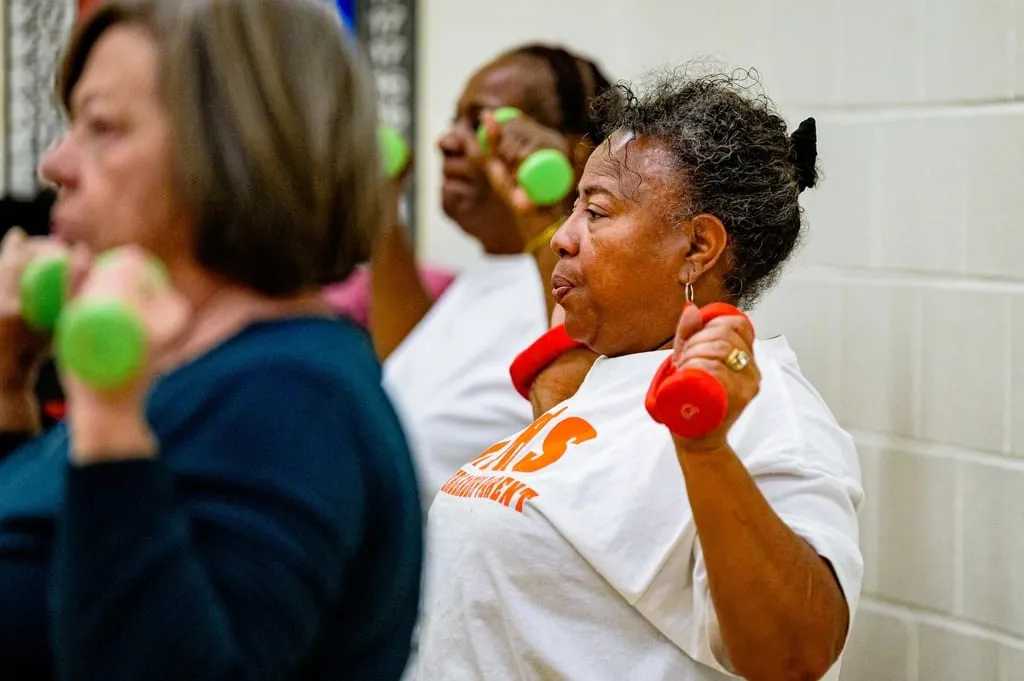
Progressive resistance training. Bone responds to mechanical strain — Wolff's law, formulated in the nineteenth century. Meaningful stimulus comes specifically from loaded and impact work rather than from activity in general. A Cochrane review found a small but statistically significant effect of exercise on bone mineral density in postmenopausal women.
Impact loading. Jumping, running, brisk walking, dancing. Even 10–20 jumps a day produce a measurable effect on femoral neck density in young women. Where osteoporosis with vertebral fractures is already established, impact work and deep forward flexion are instead restricted, and the programme should be set by a specialist.
Balance training. The frequently underrated component. A fracture is nearly always the result of a fall rather than spontaneous bone failure. A 2019 Cochrane review found exercise reduces falls in older people by around a quarter. Tai chi, balance work and leg strength training deliver more here than any supplement.
Nutrition. Calcium at 1,000 mg a day for adults and 1,200 mg for women over 50, preferably from food. Adequate protein — contrary to the old "acid load" myth, higher protein intake is associated with better bone density. Vitamin D at 800–1,000 IU where sun exposure is insufficient.
Not smoking, and moderation with alcohol. Smoking directly suppresses osteoblasts and reduces calcium absorption.
Читайте также: Calcium: How Much You Need, Where to Get It, Who Needs Supplements
Читайте также: Vitamin D: Levels, Dosage and Who Genuinely Needs It
What to expect from drugs
Where risk is high, lifestyle alone is not enough. The main drug classes are bisphosphonates, denosumab, and for severe osteoporosis anabolic agents such as teriparatide and romosozumab. All are prescription-only, chosen on calculated risk, and require monitoring.
Menopausal hormone therapy preserves bone mass and reduces fracture risk, but it is prescribed primarily for menopausal symptoms and with attention to timing — generally within the first 10 years after the final period.
What does not work: collagen as an osteoporosis treatment, silicon, the "alkaline diet", or cutting protein to de-acidify the body. None of these ideas is supported by fracture data.
Читайте также: Collagen Supplements: Do They Work and What For
Men too
Roughly one osteoporotic fracture in five occurs in men, and one-year mortality after hip fracture is higher in men than in women. Yet men are screened less often, and the diagnosis usually arrives only once a fracture has happened.
Their risk factors are the same plus some specific ones: low testosterone, long-term glucocorticoids, heavy alcohol use, and androgen deprivation therapy for prostate cancer. Screening is recommended from 70, and earlier with risk factors.
The bottom line
Osteoporosis develops across decades and stays silent until the first fracture. Prevention splits into two distinct phases: before thirty, build the highest peak bone mass you can; after that, slow its expenditure and reduce the risk of falling.
Of all the measures available, progressive resistance training, impact loading, balance work and adequate calcium and protein have the strongest support. DXA is indicated for women from 65 and men from 70, and earlier with risk factors — with treatment decided on overall risk rather than a single T-score.
FAQ
What is osteoporosis?+
A skeletal disease in which bone mineral density falls and bone microarchitecture deteriorates, sharply raising fracture risk. Formally the diagnosis requires a DXA T-score of −2.5 or below, but a fracture from minimal trauma is sufficient grounds regardless of density.
When should prevention start?+
Before thirty, because peak bone mass is reached at 25–30 and everything after that is expenditure. The higher the peak, the longer the reserve lasts. Prevention after menopause is not pointless either: it slows loss and reduces falls, and it is the fall that usually produces the fracture.
Why does menopause weaken bone?+
Oestrogens restrain osteoclasts, the cells that break bone down. As oestrogen falls, the balance tips towards resorption. In the first 5–10 years after menopause, spinal bone mineral density can fall by 2–3% a year before the rate slows.
Who needs a DXA scan?+
All women from 65 and men from 70, and earlier with risk factors: early menopause, a fracture from minimal trauma, long-term glucocorticoids, low body weight, smoking, a parental hip fracture, rheumatoid arthritis. The FRAX calculator helps assess risk before scanning.
How much calcium and vitamin D do I need?+
About 1,000 mg of calcium a day for adults and 1,200 mg for women over 50, preferably from food. Vitamin D at 800–1,000 IU a day where sunlight is insufficient. Calcium supplements beyond requirement add nothing, and their cardiovascular effects remain debated, so the logic is simple: food first, supplements only to close the gap.
Which exercise strengthens bone?+
Anything that loads the skeleton mechanically: progressive resistance training, jumping, running, brisk walking, dancing. Swimming and cycling are good for the heart but load bone weakly. A separate and crucial component is balance training: it reduces falls, and falls are the immediate cause of most fractures.
Does osteoporosis only affect women?+
No. Roughly one case in five occurs in men, and their prognosis after a hip fracture is worse. Men are screened less and later, so the diagnosis often arrives only after a fracture. Their risk factors are the same plus low testosterone and heavy alcohol use.
References
- 1.NIH Consensus Development Panel. Osteoporosis prevention, diagnosis, and therapy. JAMA, 2001
- 2.Weaver CM, et al. The National Osteoporosis Foundation's position statement on peak bone mass development. Osteoporos Int, 2016
- 3.Kanis JA, et al. FRAX and the assessment of fracture probability in men and women. Osteoporos Int, 2008
- 4.Howe TE, et al. Exercise for preventing and treating osteoporosis in postmenopausal women. Cochrane Database Syst Rev, 2011
- 5.Sherrington C, et al. Exercise for preventing falls in older people living in the community. Cochrane Database Syst Rev, 2019
- 6.Bolland MJ, et al. Effects of vitamin D supplementation on musculoskeletal health: systematic review and meta-analysis. Lancet Diabetes Endocrinol, 2018
Read next
Calcium: How Much You Need and How to Get It Without Dairy
Calcium requirements by age, the best dairy and plant sources, why vitamin D and protein matter, and who actually needs a supplement rather than taking one just in case.
Menopause explained: what changes and how to support yourself
Perimenopause vs menopause without the panic: why hot flushes, poor sleep and mood swings happen, what to do for bones and heart, protein and strength, and when to discuss HRT with a doctor.
Vitamin D and Immunity: Does It Really Help Against Colds?
What the research shows about vitamin D and respiratory infections, who a supplement genuinely helps, and where the promises run ahead of the evidence.
Lactose Intolerance: How to Tell and What to Do About It
How lactose intolerance differs from milk allergy, why most adults on the planet have it, how to test for it, and why cutting out dairy completely is usually unnecessary.

How to Boost Immunity: What Works by Science and What Doesn't
You can't 'boost' immunity with a pill. Here's what actually helps — sleep, movement, food, vaccines — and why immune boosters and vitamin megadoses do nothing.
Contraception: Methods, Effectiveness and How to Choose
A guide to birth control by real-world effectiveness: hormonal and non-hormonal, IUDs and implants, condoms and emergency contraception — with typical, not perfect, use rates.